Nail biting
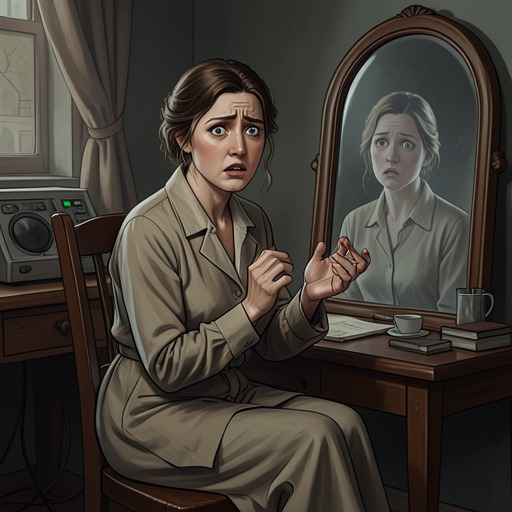
I'm Thinking of Ending ThingsNail biting is a habit The narrator has had since fifth grade, but in the novel it becomes more than a private, familiar gesture. It recurs when fear is rising, sometimes without her noticing, and becomes charged with meaning after The Caller demonstrates knowledge of it. Across a late-night phone confrontation, a dinner with Jake and Jake’s parents, and The narrator’s later ordeal inside the school, the habit connects an ordinary bodily routine to anxiety, involuntary attention, and the fear of being known by an unseen observer.
A Long-Standing Habit and an Unsettling Recognition
The narrator places the beginning of the habit in fifth grade. That history makes its later appearance feel less like a new symptom than a familiar action returning under unfamiliar pressure. When The Caller refers to her nails, she acknowledges the accuracy of the detail but calls the coincidence a fluke. The statement does not establish how The Caller learned it; instead, it intensifies the unanswered question of how someone calling from The narrator’s own number could know something so specific about her.
The calls have already unsettled The narrator’s sense of safety. They often come in the middle of the night, and she has experienced frightening awakenings in which she feels watched and unable to move. After deciding that she must answer and tell The Caller to stop, she confronts him in anger and fear, asking why he is calling and how he got her number. His apparent knowledge of her habit gives that confrontation a bodily dimension: the threat is no longer only a ringing phone or an unexplained number, but information about The narrator’s own body that she did not knowingly provide.
The Habit at Jake’s Family Dinner
At dinner with Jake and Jake’s parents, nail biting surfaces outside the phone-call scene. The narrator realizes that she has been biting her nails without being aware of it. Her index finger is in her mouth, and she notices that her thumbnail has been bitten down. The discovery interrupts the meal’s social setting with an episode of self-surveillance: an action has been taking place in plain view, yet she cannot say when it began.
The narrator wonders whether this is why Jake was looking at her. That remains her question, not a confirmed explanation of his attention. She becomes aware of a piece of nail between her teeth and, after leaving the table for the bathroom, removes it and drops it in the toilet. She also sees that the nail on her ring finger has been bitten down and that the surrounding skin is bleeding. The episode makes the habit concrete while preserving its automatic quality: she recognizes its effects only after the dinner has already carried on around her.
The moment sits amid other pressures that shape the evening. The narrator is tired, has a headache, and has drunk wine; after dessert, Jake’s parents leave Jake and her alone while an argument can be heard from the kitchen. The text does not identify any one of these circumstances as the cause of the nail biting. Their presence instead places the unnoticed gesture within a strained and unsettled evening, where the narrator is registering both her own physical state and the tension around her.
Recurrence During the School Ordeal
Later, inside the school, The narrator again notices that she has been biting and chewing her nails. She feels unwell and is trying to move toward the gym, which she hopes may offer an exit. The habit appears alongside her growing physical distress and her effort to keep moving quietly through the building. As at dinner, the action is not presented as a deliberate decision; it is something The narrator recognizes while trying to understand what is happening to her.
In the same passage, she notices strands of hair coming away when she touches her head and considers stress as a possible explanation. These observations record The narrator’s own attempt to interpret her condition, not a diagnosis supplied by the narrative. Nail biting is one part of a broader experience of bodily unease in the school, and its recurrence links this crisis to the earlier scenes without proving that every physical change has the same cause.
Narrative Function
The habit’s meaning develops through repetition and changing awareness. At first, it belongs to The narrator’s personal history; then The Caller’s reference turns it into evidence of an unnerving intimacy, though the source of his knowledge remains unexplained. At Jake’s family dinner, the narrator finds the habit happening before she has consciously registered it. In the school, she notices it again while frightened and trying to escape. The same behavior thus moves from background detail to an object of scrutiny.
This progression also complicates the difference between being observed and observing oneself. The Caller’s knowledge makes The narrator feel exposed, while the dinner scene shows that her own automatic gesture can escape her attention even in company. Later, she must monitor her actions and physical condition closely to continue through the school. Nail biting does not explain the calls or resolve the danger; its narrative force lies in how a small, longstanding habit gathers significance as The narrator’s fear and uncertainty grow.